
Third-party tracking cookies were the foundation of programmatic advertising for nearly three decades, but post-GDPR, their influence and dominance have been declining in the face of privacy concerns.
For many advertisers and media owners, the crumbling of the cookie-based infrastructure has left them with patchy visibility on audience relevance and other insights they’ve been used to when running ad campaigns.
Thanks to advances in AI and machine learning, contextual advertising has come to the fore as a powerful alternative, as it’s now developed far beyond old-school keyword matching. As the industry continues to adapt to a cookieless future, here are five ways that contextual advertising is now smarter than cookies.
1.Privacy-first by design
This is perhaps the most fundamental advantage of contextual advertising. Traditional cookie-based targeting involves tracking individuals across sites, which is now at odds with privacy regulations and consumer expectations. In addition to browser limitations, as many as 67% of US adults are actively turning off cookies or website tracking to protect their privacy, according to research.
Contextual advertising on the other hand targets the content environment, not the person, removing the need for personal data, user IDs, or consent mechanisms.
And this isn’t just a compliance benefit; it’s a performance one too. When campaigns aren’t limited to the shrinking pool of users who’ve consented to tracking, they can reach the full breadth of quality audiences across the open web. Illuma’s approach goes further still, using the live contextual interests of a brand’s known audiences to inform targeting – effectively combining the intelligence of behavioural data with the privacy credentials of contextual, without ever looking at an individual user ID.
2. Real-time, agentic decisioning
Cookie-based targeting relies on historic browsing behaviour to profile individuals and predict current intent – which isn’t always accurate. By the time an advert is shown, someone’s mindset or situation might have changed, leading to wasted ad spend.
Legacy contextual targeting, using static keyword lists, also has the same problem: ad buyers pre-select topics and keywords they think the user would be interested in, launch the campaign, and hope for the best. If something isn’t working, there’s no way to adapt fast enough to put it right.
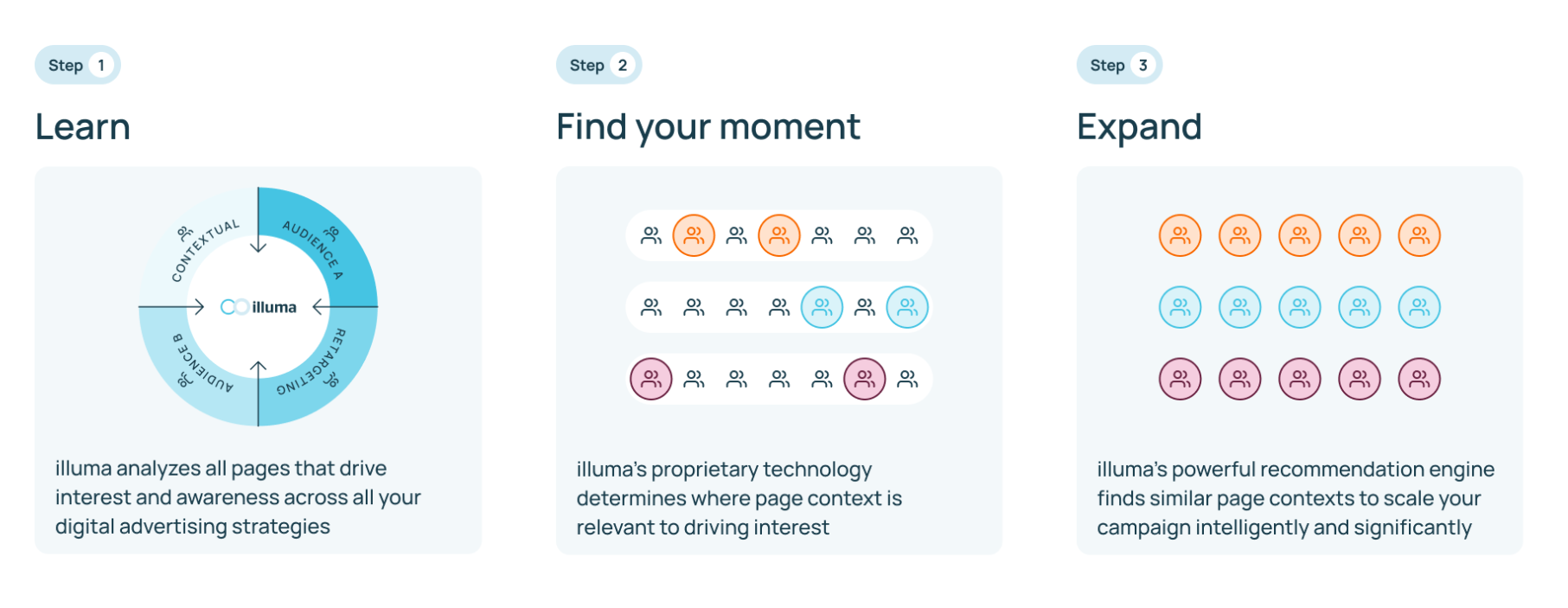
Contextual has moved on considerably thanks to advances in technology. Illuma’s AI, for example, combines a human-trained content categorisation engine for more accurate buying and selling, with agentic decisioning models, which actively steer placements towards the best performing inventory as it emerges. The results are stronger, more dynamic campaigns with more accurate targeting and greater ROI.
3. Audience discovery across multiple content topics
One of the biggest limitations of cookies is that they bundle people into buckets of assumed interests based on browsing trends. But of course, people have multiple interests and those change all the time – what engages someone one week may be totally irrelevant a week later.
Picture someone researching a holiday: they spend several days reading travel content, comparing hotels, and eventually make a booking. For the next month, they’re still followed around the web by travel ads – even though their interests have moved on to other things. The moment of relevance for the travel campaign has passed, and the ad spend is potentially wasted.
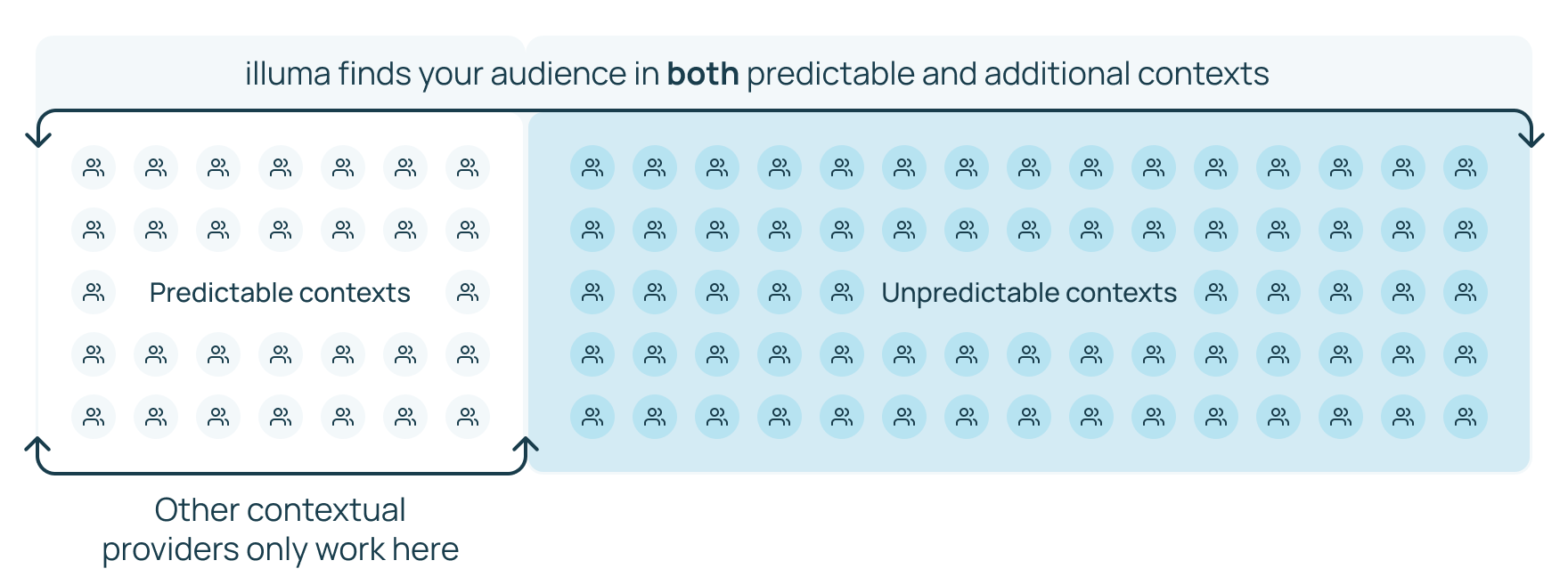
Illuma Reacts™, by contrast, analyses what’s actually working right now, and where engagement is currently happening, not where it happened last month. It also reveals something far more interesting: evidence that audiences engage with brand messaging across a much wider range of content than anyone could predict.
During a recent illuma campaign for a hotel group, one of the top-performing categories was health and fitness, specifically pages about fitness routines and gut health. Another campaign for a motor brand performed better in content about fine art and current affairs than in content about cars.
In fact, illuma data shows that as much as 60% of campaign success can happen off-topic, in contexts that no media planner would have pre-selected. That’s a huge amount of opportunity that cookie-based targeting and legacy keyword strategies have simply left on the table.
4. Intelligent scaling without diluting relevance
Cookie-based targeting uses lookalike modelling to scale campaigns – but there’s a fundamental trade-off. The further you expand from your original audience, the more relevance can drop and the more ad performance can be diluted. Cookie-based advertising offers reach or relevance, but rarely both – and there’s also that privacy niggle, too.
By using live content consumption patterns as a data input, campaigns can scale and expand into new environments without sacrificing audience quality. As an example, illuma Reacts™ delivered a 79% improvement in audience quality for a recent pharma campaign, compared to non-illuma lines, while simultaneously increasing qualified reach. This example shows scale and relevance working together, not against each other, something that cookie-based targeting simply cannot replicate.
5. Seamless cross-screen delivery
Cookies were built for desktop browsers – they’ve always been limited with mobile, and they simply don’t work in connected TV environments. As premium video and CTV continue to grow, any cookie-dependent programmatic advertising strategy will inevitably hit a wall.
AI-powered contextual advertising on the other hand, doesn’t face this limitation. The same audience modelling and contextual expansion logic works across web, apps and CTV, offering a consistent approach wherever audiences are consuming content. Previous illuma campaigns in the pharma sector have achieved video completion rates up to 20% above benchmarks across diverse audience segments in video and CTV environments – results that cookie-based targeting would struggle to match.
The bottom line
The ongoing shift away from cookies isn’t something to fear – it’s a business opportunity. The industry spent years bracing for disruption, but what’s emerging is something better: targeting that’s smarter, faster, more respectful of privacy, and measurably more effective.
Contextual advertising isn’t just filling the gaps that cookies have left behind – it’s outperforming them on the metrics that matter. Real-time adaptation, intelligent scale without dilution, cross-screen consistency, and privacy by design. These aren’t compromises or workarounds, they’re genuine improvements to the fundamental technological processes which underpin programmatic advertising.
Want to see how Contextual AI can work for you?
Get in contact to set up a test campaign