
Beyond the taxonomy node: Why contextual classification needs to evolve

Article by Dr Yu Liu, Head of Data and Technology at illuma
Two pieces of finance content can share the same IAB label but offer very distinct advertising opportunities. If brands are to reach the right audiences, classification needs to evolve beyond static labels, says Dr Yu Liu.
Journalists have written and talked about business and finance for decades, yet it remains one of the trickiest contextual verticals to advertise against. Not because it’s under-categorised, but because the IAB taxonomy wasn’t built for the variety of content that sits within it.
For example, a sober business update about mortgage policies and an alarmist consumer piece about interest rates can both be tagged ‘Business & Finance > Economy > Interest Rates’. The same tag is steering advertising towards very different content environments, with potentially very different audience and commercial implications.
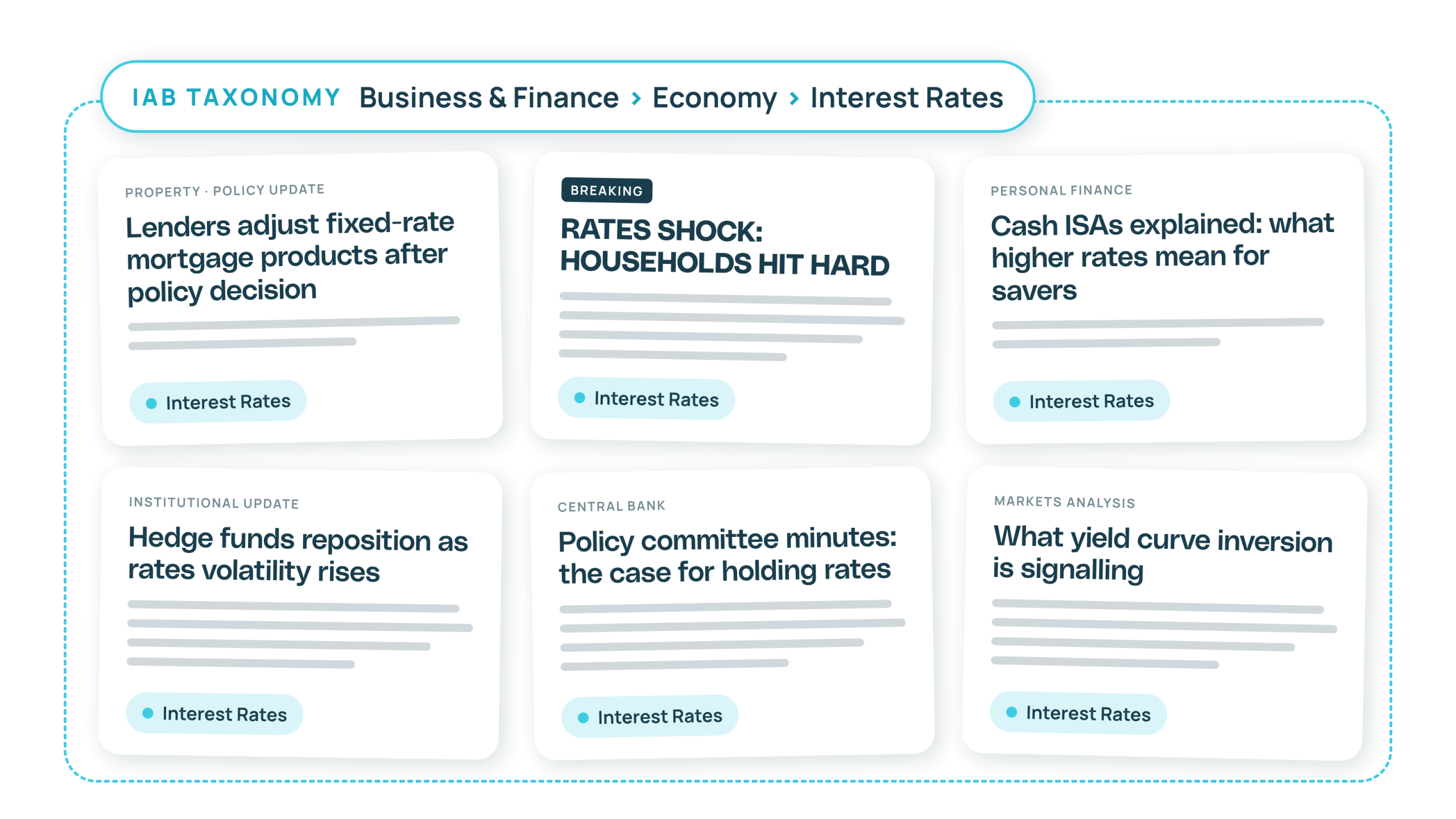
Financial writing also carries dense, domain-specific terminology (‘basis points’, ‘yield curve inversion’, ‘delta-hedging’) that signals distinct meaning, which can be lost once content is reduced to a single label. In fairness, the IAB taxonomy does run deep.
Version 3.1 contains 700 categories across a four-level hierarchy, and finance has two top-level branches, ‘Business and Finance’, and ‘Personal Finance’. Yet the resolution needed, particularly for specialist quality media, goes beyond what a fixed classification system can reliably deliver.
From labels to meaning
Conventional supervised classification relies on having sufficient labelled examples at each level of the taxonomy. But at the scale and depth of business and finance content, building and maintaining that ground truth can become a significant challenge.
Another approach is to use the underlying meaning of content to identify relationships between individual pieces and the categories they represent. Rather than relying on thousands of labelled examples for every category, representative descriptions and the relationships between content can support classification across the full hierarchy.
This approach can make a particular impact in business and finance, where accurately labelled data can be hard to come by. Distinguishing, for example, between a retail ISA explainer and a hedge-fund positioning note requires domain expertise, which is a far costlier task than other verticals demand.
By identifying these meaningful relationships between content and categories, we can reduce that reliance on extensive labelled datasets and make greater use of the full depth of the taxonomy, rather than quietly collapsing back to Tier 1.
When taxonomy runs out of road
Even with this system in place, a 700-node taxonomy still has a resolution ceiling, and financial content routinely needs finer distinctions. Rather than petitioning the IAB for more nodes, at illuma we’ve started to let the classification system generate its own.
As human corrections are made to URL classifications, they are periodically arranged into a custom, emergent taxonomy layer alongside the standard tree.
These layers capture recurring patterns in the corrections, creating additional categories where the content demonstrates meaningful similarities. New content can then be assessed against both the standard taxonomy and this additional layer, allowing the classification system to better recognise these distinctions.
Over time, a single node such as ‘Personal Finance > Personal Investing’ can split into distinct sub-layers as corrections accumulate. A retail-savings sub-layer and a derivatives/hedge-fund sub-layer may share the same Tier 2 label, yet carry clearly different content characteristics.
The finer categories emerge from patterns in those corrections rather than being defined in advance, offering a more scalable way to capture distinctions that a fixed taxonomy cannot easily accommodate.
Bringing video into the picture
Of course, text-based content is far easier to categorise than video and audio, because the terminology is already there to read. CTV, broadcast clips and earnings-call footage often carry no on-page copy, only audio and video, at volumes where managed transcription or manual review become cost-prohibitive.
At illuma, we treat each video as two parallel extraction tasks. For audio, speech is extracted and converted into text, which is then processed through the same content-understanding pipeline used for written material. For visuals, sampled frames are analysed using multimodal AI to extract meaning from scenes with no legible text. Because one video can span multiple topics, analysis takes account of multiple frames rather than relying on a single snapshot.
The aim is to use more computationally intensive analysis where it is needed to interpret audio and visual material, while keeping the subsequent classification process efficient. This allows the approach to extend to video and audio without making every stage of analysis unnecessarily expensive.
IAB as a foundation, not a ceiling
Going back to the example of the sober mortgage update and the shock interest-rate piece. Under a single IAB label, they might fall into the same category; but illuma’s approach can distinguish between them through a more detailed understanding of their content, informed by human corrections.
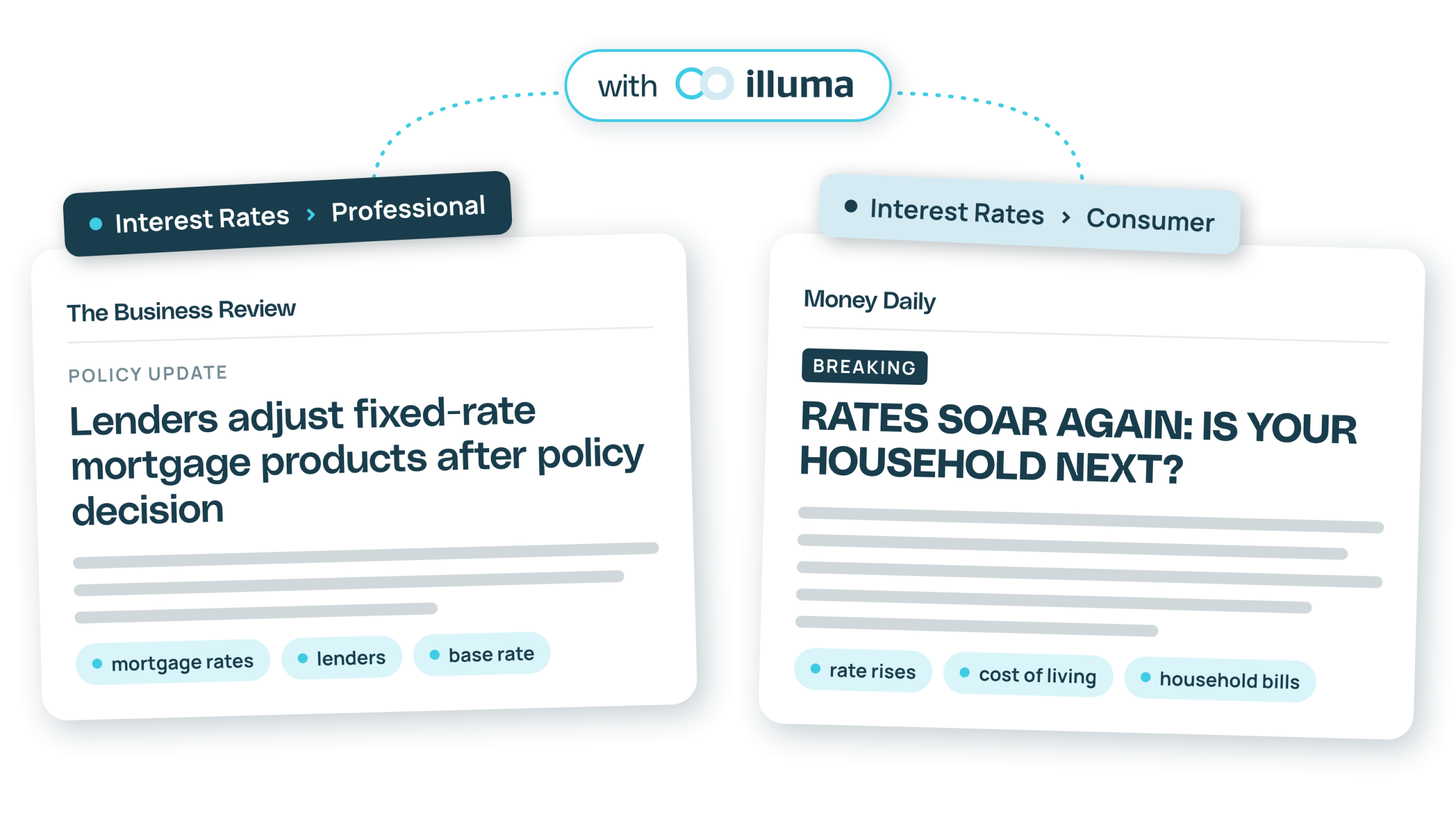
This makes greater use of the full depth of the taxonomy possible without requiring thousands of labelled examples for every category. An emergent layer adds the finer distinctions finance demands, while the same underlying content intelligence extends to video and audio where there’s no copy to read.
For advertisers, that means an ISA provider and a derivatives broker no longer compete for the same inventory simply because they share a Tier 2 label. For specialist publishers, it means the depth and variety of their journalism can finally be reflected in how it’s bought.
None of this argues against the IAB taxonomy – it remains the common language the industry trades upon. But with continual learning and improvement, it can be a foundation rather than a ceiling.